
Minneapolis · St. Paul · Twin Cities Metro
Put the ladder away for good
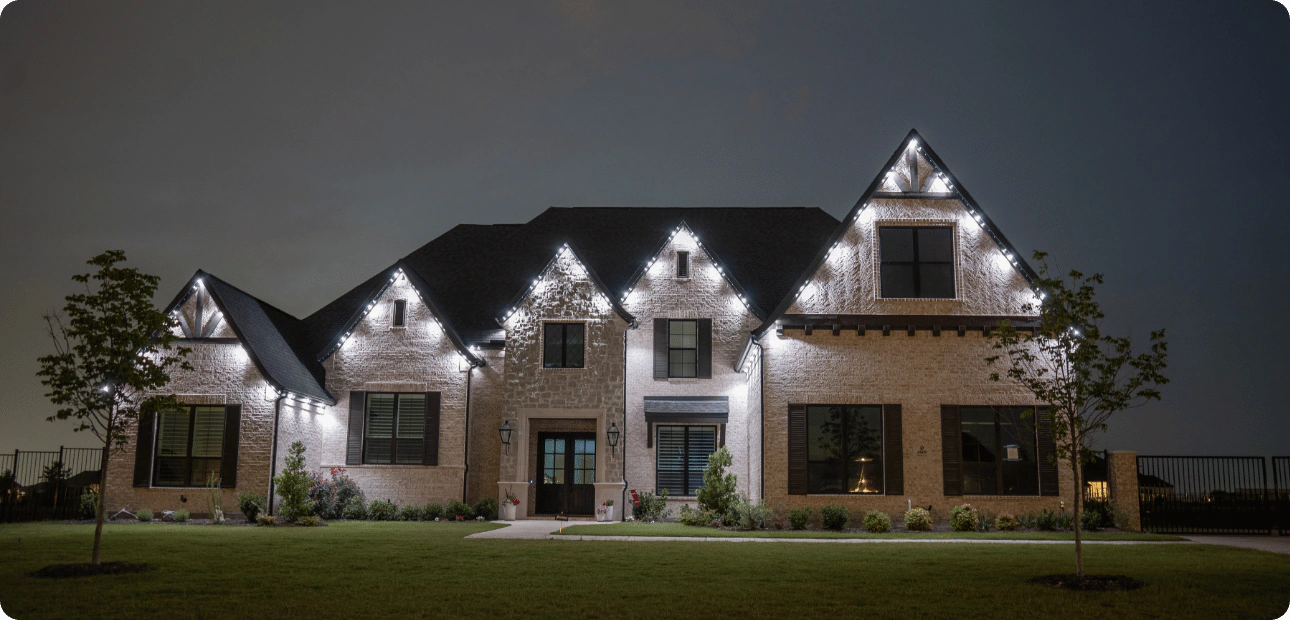
Permanent LED lighting installed along your roofline once. Warm white on a Tuesday, red and green in December, gold on game day — all from your phone. It disappears into your trim during the day and it stays put through Minnesota winters.
Priced by the foot, quoted in writing · Free on-site measure · Authorized Bosso Dealer
Every November
You already know how this goes
If you've hung lights on a Minnesota house, none of this needs explaining.
- A ladder on frozen ground, in November, usually alone.
- Half a Saturday up, another half day down in January.
- A box of tangled strands where a third of them don't light.
- $800 to $1,500 a season if you pay somebody to do it.
- And it still looks like lights you hung, not lighting you own.
The alternative
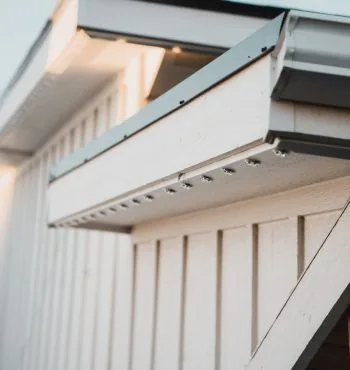
Permanent lighting is installed one time. The track is fastened under your roof edge, color-matched to your fascia, and wired to a controller by an outlet. After that you never touch it — you open an app, pick a color or a scene, and the house does the rest. There is no seasonal install, no takedown, and nothing to store.
It costs more than one season of hired help and less than about five. After that it's just part of the house. We show that math against what Christmas light installation costs in Minneapolis year by year.
If December is what brought you here, we go deeper on permanent Christmas lights — same track, same install, it just happens to be red and green for six weeks. If you'd rather have it for every holiday than book holiday light installation a season at a time, that page covers the whole calendar.
Same house, four moods
Drag it and see
One system, re-colored whenever you feel like it. No re-install, no add-on kits.
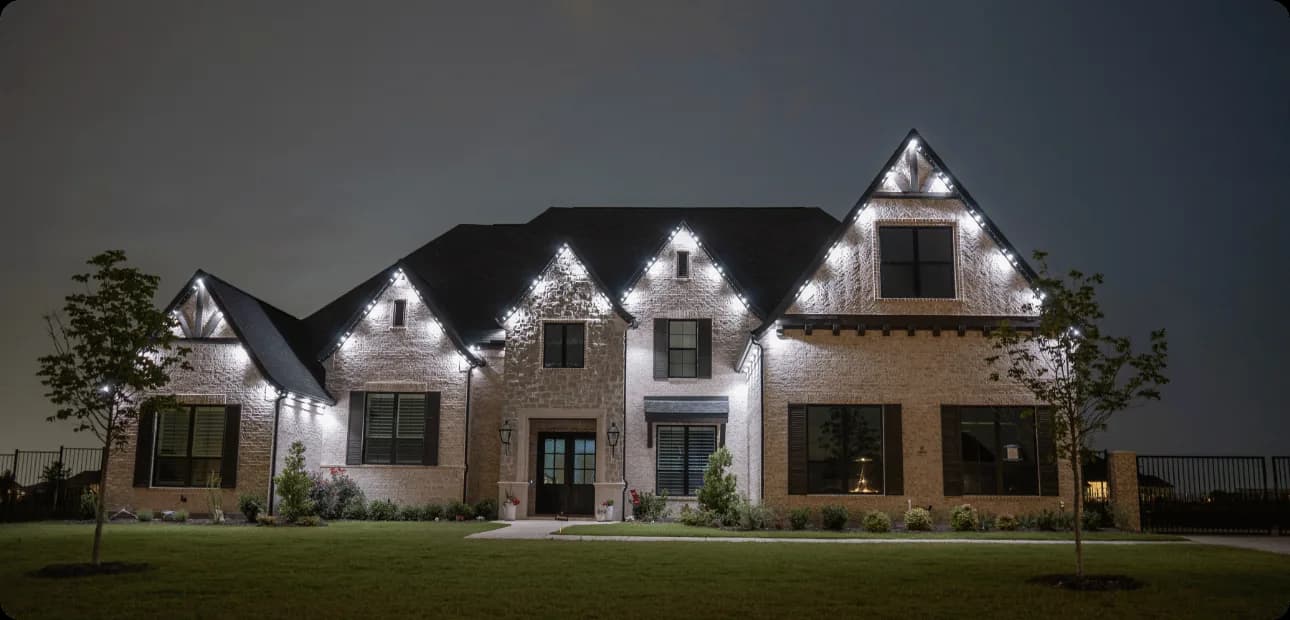
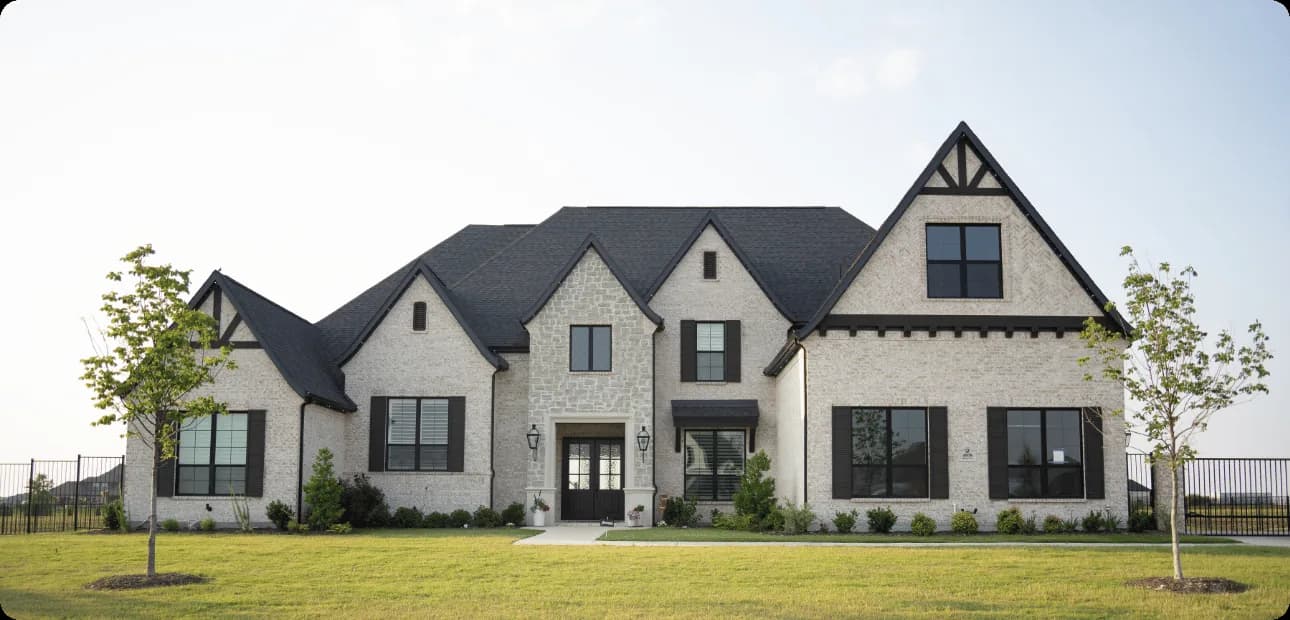
That's one house, four ways. If you'd rather see a range of finished work, the permanent lighting gallery.
Straight answer
What permanent lighting actually costs
Permanent lighting is priced by the foot of roofline, so the honest answer is that it depends on your house. We walk your roofline, count the feet, and put the exact number in writing before you commit to anything.
Three things move that number: how many feet you cover, how many stories we have to reach, and how complicated the roofline is. A single-story rambler with a simple front gable sits at the bottom of the range. A two-story with dormers and multiple peaks sits at the top.
You'll see “starting at” prices advertised around town. Those usually cover about 85–100 feet — the front of a small single-story. It is not what most houses cost. We'd rather measure your actual roofline and give you a real number than hook you with a teaser that won't match your house.
Nothing hidden
A deposit at signing covers your materials; the balance is due when it's installed and working. Both numbers are on the written quote.
One day, usually
Most homes finish in a single day. If yours is a two-day job, we tell you before we start.
No electrician
The controller plugs into a standard exterior outlet.
5 years parts, 5 years labor
Backed locally by the crew that installed it — the part and the visit are both covered.
Control
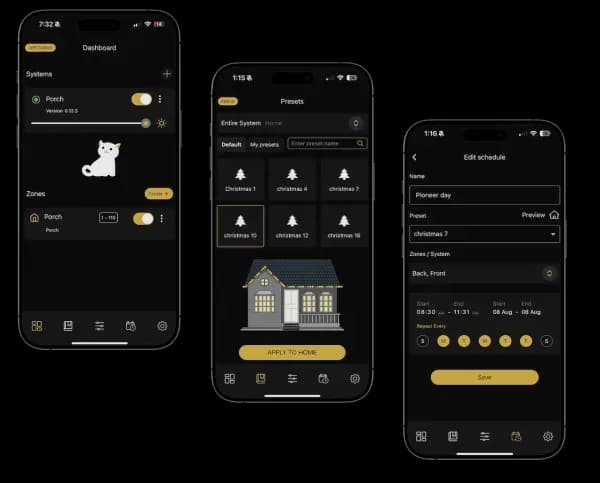
The part you'll actually use every day
You'll touch the app far more than the hardware, which is exactly why we picked the system we did.
Every bulb, its own color
16 million colors plus warm-to-cool white, per fixture.
Scenes and schedules
Set it to come on at sunset and shut off at midnight. Then forget it.
Zones
Front, garage, and back can all do different things.
Voice
Works with Alexa, Google Assistant, and Siri.
Music sync
The house moves with whatever's playing. Included, not an upgrade.
No subscription
Every feature comes with the system. No monthly bill after the install.
Most people run warm white almost every night and save the color for holidays, birthdays, and game days. That's the honest usage pattern.
How it goes
Three steps, then you're done forever
01
We measure and design
We walk your roofline, count the feet, and show you where the track goes and what it'll look like lit. You get a real number the same visit.
02
We install it
One day for most homes. Track goes up color-matched and tucked under the edge so it reads as a shadow line during the day.
03
We hand you the app
Before we leave, we set up your phone, build your first few scenes, and make sure you can drive it yourself.
Why Gray Duck
We come from exteriors, not from lights
Permanent lighting gets installed on fascia, soffit, and roof edge — the parts of a house most lighting companies have never had to think about. We have. That's the difference between a clean line that lasts and a run of track that sags in three winters or leaves you with holes in the wrong places.
It's also why we treat soffit lighting as its own conversation. Where the track sits changes how the light lands on the house, and not every roofline wants the same answer.
Locally owned, both partners on the job
Joe runs design and sales. Mike runs installs and stands behind the crew's work. You'll deal with one of us, not a call center.
We tell you when the answer is no
If your roofline is a bad candidate, or the weather won't let us do it right, we'll say so and reschedule instead of forcing it.
One system, chosen on purpose
We install Bosso Smart Lighting because the fixtures hold up and the app is genuinely good. We're not juggling five product lines to hit a quota.
If you're still shopping brands, we put the honest version side by side — how Bosso Smart Lighting compares to Trimlight and JellyFish, including where the other guys are the better call.
Or read how Joe and Mike got here before you let anyone on your roof.
Questions we get every week
Straight answers
How much does permanent outdoor lighting cost in Minneapolis?
Permanent outdoor lighting is priced per linear foot of roofline, so your total depends on how much of the house you light — we measure your actual footage and put the exact number, per foot and in total, in writing at a free visit. Price moves with three things: how many feet you cover, how many stories the crew has to reach, and how complex the roofline is. A single-story rambler with a simple front gable sits at the low end. A two-story with dormers, multiple peaks, and a wraparound covers more feet and takes longer, so it costs more.
Why is the advertised 'starting at' price rarely what permanent lighting costs?
A "starting at" price usually buys 85–100 feet — enough for the front of a small single-story home, not a whole house. It is a real number for a small job, but most homes need more than double that footage, so the quote you actually receive is rarely the advertised one. Instead of a teaser, we measure your actual roofline and put a real number in writing at a free visit — so the price you see is the price for your house, not the smallest job we'll take.
Do you require a deposit?
Yes. A deposit at signing covers your materials, which are ordered specifically for your home, and the balance is due when the system is installed and you have seen it working. The exact amount is spelled out in your written quote before you sign anything.
How does your price compare to Trimlight or JellyFish quotes?
Directly, where the other brands let you check: Trimlight publishes $18–35 per foot nationally — a wide range because it varies by dealer and market — and JellyFish publishes no pricing at all (quotes are in-home only). A professionally installed RGBW system in the Twin Cities sits in that professional range, and we put your exact number in writing on the proposal. When you compare quotes, compare two things: the per-foot rate written on the proposal, and what the install includes — surge protection, ice-rated fastening, and who services it are where cheap quotes usually got cheap.
Can you see the lights during the day?
Barely. The track is color-matched to your fascia or trim and tucks under the roof edge, so from the street it reads as a shadow line. Most homeowners tell us their neighbors do not notice anything until the lights come on.
Will permanent lights survive a Minnesota winter?
Yes — that is the whole reason the system exists here. The fixtures are sealed and rated for outdoor use through freeze-thaw cycles, ice, and summer heat. We install with Minnesota in mind: the track is fastened to handle ice loading and expansion, and the wiring is run so meltwater has somewhere to go.
What can the lights actually do?
Every fixture is individually addressable, with 16 million colors and adjustable warm-to-cool white. From your phone you can run warm white for everyday curb appeal, set holiday scenes, sync to music, schedule by sunset, and control zones independently. Most people use warm white most nights and save the color for holidays and game days.
Who makes the system you install?
We install Bosso Smart Lighting. We looked at several manufacturers and chose Bosso for the fixture quality and, honestly, for the app — you will interact with the app far more than the hardware, and a bad app ruins a good lighting system.
How long does installation take?
Most homes are finished in one day. Larger or more complex rooflines run into a second day. We tell you which one you are before we start, not after.
Do I need an electrician?
No. The system plugs into a standard exterior outlet. If your home does not have an outlet where the controller needs to live, we will flag it during the estimate so there are no surprises on install day.
Can you install in the winter?
Sometimes. We install through December when weather allows, and we are honest about when it does not — hanging track on an ice-covered fascia is how installers get hurt and how jobs get done badly. If we cannot do it right, we will schedule you for the spring and tell you that up front.
What happens if something stops working?
You call us and we come out. Every system we install carries 5 years on parts and 5 years on labor, backed locally by us. Service calls go to the same crew that did your install.
There are more where those came from — the full permanent lighting FAQ covers cost, HOAs, energy use, and the questions installers tend to dodge.
Free design consultation
Let's see what your house looks like lit
We'll measure your roofline, show you the options, and give you a real number. No pressure, no all-night pitch.