Warm White Outdoor Christmas Lights: Why Most of Them Aren't

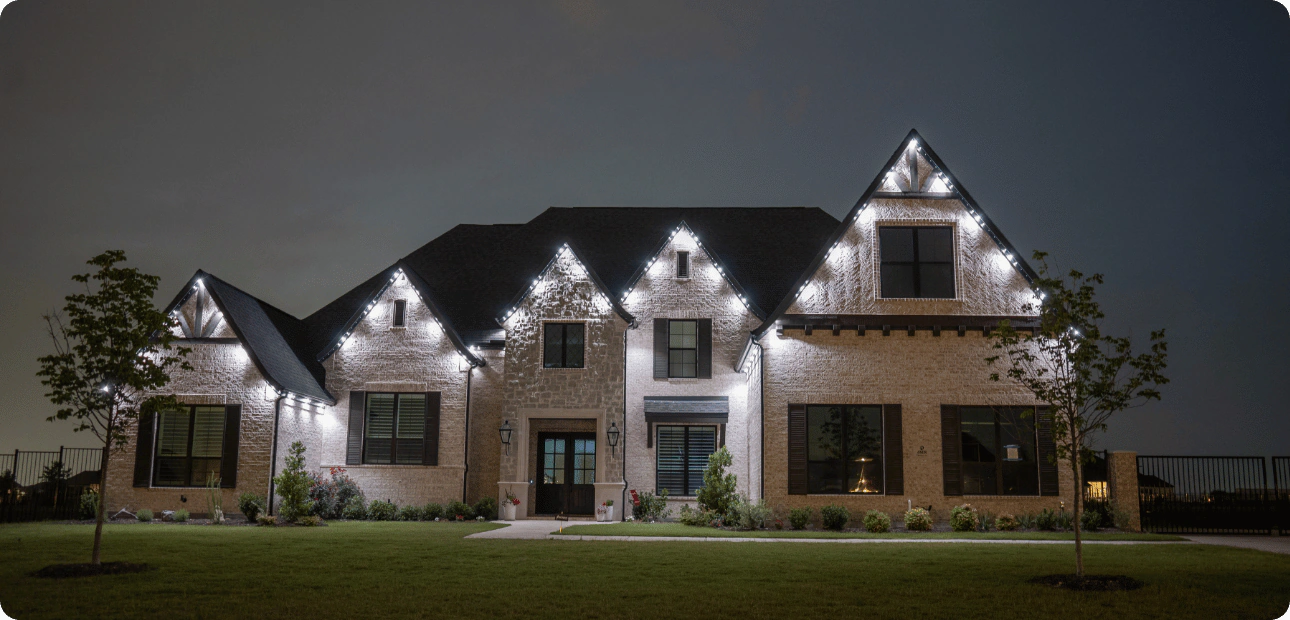
Ask most homeowners what they want their roofline to look like in December and the answer isn't a rainbow. It's warm white. The classic look — the one that reads as "Christmas" from the street instead of "casino."
Here's the problem nobody mentions in the sales pitch: a lot of permanent outdoor lighting can't actually make warm white. It fakes it. And once you know what to look for, you can see the difference from the end of the driveway.
The quick answer
Most permanent outdoor lights produce "warm white" by mixing their red, green and blue diodes together, because they have no white diode at all. Blended white tends to look slightly pink, purple or cold, and it's dimmer, because every color channel is working to imitate a color none of them is. A system with a dedicated warm-white diode — RGBW instead of RGB — makes white from a white LED, so it looks like an incandescent bulb rather than an approximation of one. Check two things on any spec sheet: whether it says RGB or RGBW, and whether it publishes a Kelvin (color temperature) rating. Several major brands publish neither.
Why does "warm white" look purple on some houses?
Because it isn't white light. It's three colored lights pretending.
An RGB fixture has three diodes: red, green, blue. Turn all three up and your eye reads the mix as white-ish. Tune the ratios and you can push it toward "warm." But the mix is never exactly right, it shifts as the diodes age at slightly different rates, and the blue channel tends to bleed through at the edges. That's the faint purple cast you've seen on houses where the owner clearly picked "warm white" in the app and got something close to it instead.
An RGBW fixture adds a fourth diode that is simply white. When you ask for warm white, that diode does the work. The color diodes stay available for holidays and game days, but the everyday look — which is what most systems show most nights of the year — comes from a light built to be white.
What do the major brands actually publish?
I went to each manufacturer's own published specs. Here's what they say about white light, taken from their own materials rather than from a salesperson.
| Brand | Diodes | Published brightness |
|---|---|---|
| Bosso | RGB + dedicated warm white | 72 lumens per fixture |
| EverLights | RGBW | 70 lumens |
| Trimlight | RGB only | 20–60 lumens (by model) |
| JellyFish | RGB (whites blended) | up to 21 lumens per bulb |
Two things stand out.
First, Trimlight and JellyFish blend their whites from color. Neither has a dedicated white diode. That isn't hidden — it's in the specs — but it's rarely the first thing mentioned.
Second, color temperature is hard to find. Kelvin is the number that tells you whether "warm white" means a cozy 2700K incandescent glow or something closer to a 4000K office ceiling. Neither Trimlight nor EverLights publishes one. When a brand doesn't, you're buying "warm" on trust — so ask for it in writing.
How can you tell before you buy?
You don't need a lab. Three checks will do it.
- Read the diode line, not the color count. "16 million colors" tells you nothing about white. Look for "RGBW" or "dedicated white diode." If the spec says RGB, the white is blended.
- Ask for the Kelvin number. Warm white for a house usually means somewhere around 2700K to 3000K. If the installer can't tell you, that's an answer too.
- See it lit, in white, at night. Not the demo video set to rainbow chase. Ask to see a finished install running plain warm white. Stand at the street and look at the corners and the far end of the run — that's where blended white gives itself away.
Is warm white the only reason to pick a system?
No, and I'd be doing you a disservice if I said it was. Brightness and white quality are where the brand we install leads on published specs. It isn't where it leads on everything: Bosso's control is cloud-dependent, so an internet outage means the app can't reach the lights until it's back. Gemstone publishes a longer warranty. Trimlight publishes more of its pricing. If one of those matters more to you than the color of your everyday white, weigh it that way — the full brand comparison lays all of it out side by side.
But if what you picture is a warm, classic roofline on a December night — the house that looks like Christmas instead of a light show — the diode line on the spec sheet matters more than almost anything else on it.
Common questions
Are warm white and soft white the same thing?
Close, but not quite. Both describe the low end of the color-temperature scale. Manufacturers use the names loosely, which is exactly why the Kelvin number is more useful than the label.
Can RGB lights make a good white at all?
They can make a passable one, and some homeowners are happy with it. The trade-off is brightness and consistency: blending three colors costs output, and small differences in how each diode ages can pull the white off-tone over time.
Does a dedicated white diode still do holiday colors?
Yes. RGBW means the red, green and blue diodes are all still there for color. The white diode is added, not swapped in.
Want to talk through warm white for your own roofline? Set up a free visit — evenings and Saturdays work — or call 952-900-2733.
About the author
Joe Dvorak · Co-owner, Gray Duck Lighting
Joe Dvorak co-owns Gray Duck Lighting and has spent his career in Twin Cities exterior contracting. He also owns Modern Exterior Systems, a Minnesota roofing and siding company.
Keep reading
Game Day Lighting Ideas for Your House (Minnesota Edition)
Game day lighting ideas for Minnesota homes — Vikings purple and gold, Gophers maroon, Wild green — and the team colors LEDs struggle to get right.
When to Book Permanent Christmas Lights in Minnesota
August to early October is the right window for a Minnesota install — daylight and dry fascia, not fake urgency. What changes after Thanksgiving.
Permanent Lighting Warranties: What's Actually Covered
'Lifetime' warranties in permanent lighting have asterisks: daytime-use exclusions, 30-day registration deadlines, and labor that isn't covered. Quoted in full.