The Brand On The Box Matters Less Than The Crew On The Ladder
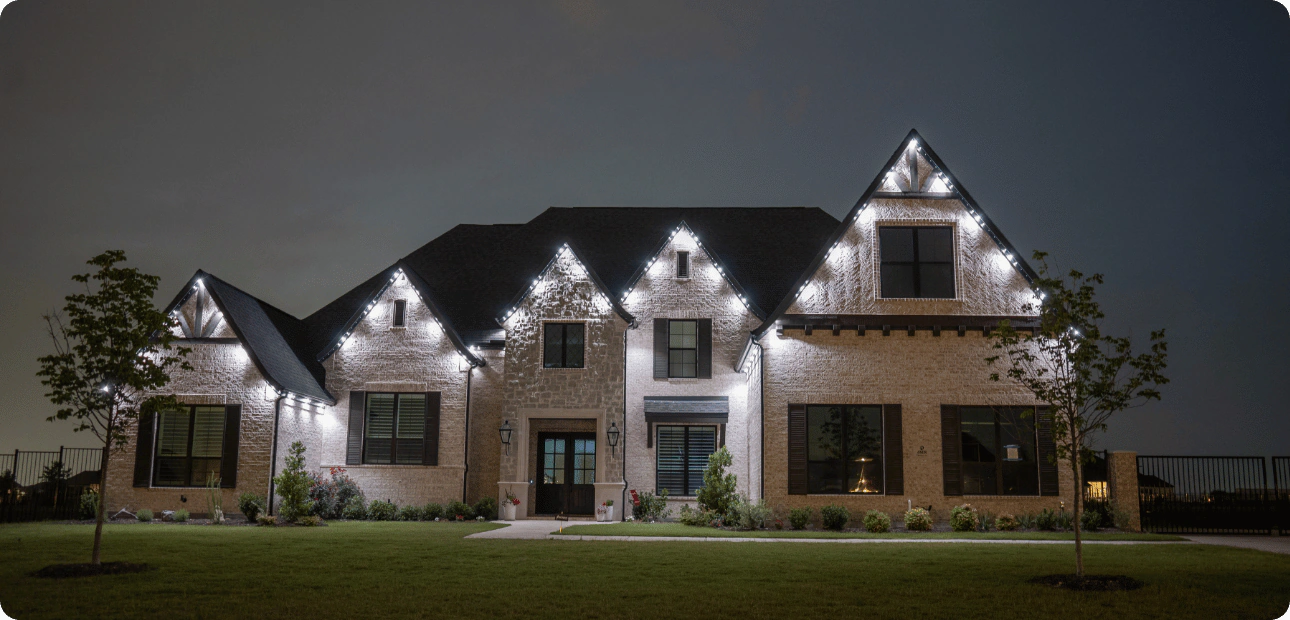
For about eighteen months, alongside our own work, our crews have been hired as a subcontractor to do installs and service calls for a different permanent lighting brand here in the Twin Cities. To be clear about the arrangement: we're the labor. We don't sell that brand, we're not a dealer of theirs, and we don't carry it — they hire our crew because the work needs doing right.
That means we've spent a year and a half being sent to houses somebody else installed — to finish them, or to fix them.
Mostly to fix them.
Not warranty parts failures. Installs. Track hung crooked enough that you can see it from the driveway. Wire runs that were never sealed. Controllers mounted where nobody could reach them without a ladder and a flashlight. In a fair number of cases we were the third crew to touch the house.
I'm not going to name the brand, and I'm not going to pretend the product was the problem — it wasn't. The hardware was fine every time. What varied was who hung it.
That experience changed how I talk to homeowners about this product. Everybody shopping permanent lighting starts by comparing brands — lumens, warranty length, whose app is better. Those comparisons matter, and we published an honest one. But they're not the thing most likely to determine whether you're happy with this system in year three.
The crew on the ladder is.
The quick answer
In permanent outdoor lighting, installation quality affects your long-term satisfaction more than the brand you choose. Every major manufacturer sells a competent product with a 50,000-hour LED rating. What varies enormously is who physically installs it, whether that crew works for the company that sold it to you, and whether anyone answers the phone in year three. Ask any company you're considering two questions: do your own employees install this, or do you subcontract it, and who comes out when something fails two winters from now?
The part of this industry nobody advertises
Almost every permanent lighting brand you can buy is sold through a dealer network. That's not a knock — it's just how the category is structured. But it means the company whose name is on the product is usually not the company that shows up at your house.
The manufacturers say this themselves, in writing. Trimlight's own warranty page states that Trimlight HQ "is the manufacturer of your lighting system and is not responsible for installation, support, or repairs," and that the labor warranty "is provided by your local dealer." Gemstone's warranty covers one year of labor and notes that beyond that, "service charges may apply unless your dealer offers additional coverage." EverLights' warranty document says outright that it covers the product, "not any associated labor for installation."
Read those together and the picture is clear: the manufacturer covers the parts. Everything about your actual experience — the install, the service call, the person who picks up the phone — belongs to whoever sold it to you.
Then there's a second layer most homeowners never learn about. Many dealers don't employ install crews either. They sell the job and subcontract the installation to whichever crew is available that week. So the company you vetted, whose reviews you read, whose salesperson you liked — may not be the company on your roof.
What bad installs actually look like
I want to be specific here, because "quality install" is the emptiest phrase in contracting. Here's what we actually find when we get called to fix somebody else's work.
Track that follows the crew instead of the house. Good track follows the fascia line so precisely that it disappears. When it's rushed, it wanders — a quarter inch off over twenty feet, which nobody notices during install and everybody notices from the street at night when the light line has a wave in it.
Fasteners in the wrong place. Into the gutter instead of the fascia. Too few, so the track sags between them by the second summer. Or too many, driven too hard, dimpling aluminum trim.
Connections that were never sealed for Minnesota. This is the big one. Every one of these systems has connection points, and every one of those points sits outside through freeze-thaw cycles. Water gets in, freezes, expands. Come March you've got a dead section and no obvious reason why. This is the single most common failure we're called out for, and it is almost always an install problem rather than a product problem.
Controllers mounted for the installer's convenience. Behind a shrub. In an attic with no light. Ten feet up a wall. It works fine on day one. It's miserable on the day it needs a reset.
Wire runs that ignore how water moves. Meltwater comes off a roof in predictable places. Wire needs to be run so that water has somewhere to go that isn't along the wire and into a connector.
None of these show up in a brand comparison chart. All of them determine whether you like this system in three years.
Why we don't subcontract
We have never hired a subcontractor for one of our installs. Not once, not in a busy week, not in October. Every Gray Duck system on a Twin Cities house was put up by our own crew — our people, on our payroll, trained by us, working to checkpoints we inspect.
Trained by us. Quality control checkpoints by us.
Those two things are what you actually get out of an in-house crew, and neither is available for hire.
Our installers are trained by us, on this specific system — not certified once by a manufacturer in a hotel conference room, but taught by the people who'll be reviewing the work. And we run quality control checkpoints during the install, not a glance at the end:
- The track line — checked against the fascia before it's fully fastened, while it's still cheap to correct.
- Fastener placement and spacing — into fascia, not gutter; enough of them, not overdriven.
- Every connection sealed — inspected individually, because this is the failure that shows up two Marches later.
- Controller and transformer location — reachable by you, protected from pooling water, on an outlet that exists.
- Wire routing against meltwater — run so water has somewhere to go that isn't a connector.
Each of those gets checked while the ladder is still against the house. A defect caught at that moment costs an hour. The same defect caught in February costs a truck roll, a callback, and your patience.
That's a real business cost. Subcontracting is more flexible and it scales faster in a category with a hard seasonal peak. Most companies in this space do it for exactly that reason, and I understand why. We decided the tradeoff wasn't worth it, and eighteen months of cleaning up other crews' work is why.
But every repair we've been called out to over the last year and a half traced back to the same root cause: nobody on that roof had any stake in what the house looked like in year three. A sub gets paid for the install. The callback is somebody else's problem. That's not a character flaw in subcontractors — it's what the incentive structure produces.
When our own crew does it, the person who hung your track is the person who comes back if it fails. That single fact changes how carefully the work gets done, and it's the closest thing to a quality guarantee that exists in this trade.
One thing this doesn't mean
To be straight with you about what we do and don't do: we service the systems we install. We're not a repair shop for other companies' lighting.
That isn't us being precious about it — it's a hardware reality. These systems use proprietary track, connectors, and controllers, and we can't buy another manufacturer's parts. Anyone who tells you they'll keep your out-of-warranty competitor system running indefinitely is either stocking salvaged parts or guessing.
If you already own a system that's failed and the company that installed it has gone quiet, we'll give you an honest look and tell you whether it's worth anything — but the honest answer is usually replacement, not repair. We wrote up how that works here.
The questions to ask anyone you're considering
Ask us these too. If a company won't answer them plainly, that's your answer.
- Do your own employees install this, or do you subcontract? If subcontracted — will the same crew come back for service?
- Who holds the labor warranty, you or the manufacturer? Get the number of years in writing on the proposal, not verbally.
- What's your response time on a service call in February? Winter is when these systems fail and when nobody wants to climb.
- How do you seal the connections? You want a specific answer about a specific product, not "we make sure it's watertight."
- Where will the controller go, and can I reach it? Have them show you the spot before install day.
- How long have you been installing this specific system? Not "in business" — installing this product.
- Who trains your installers, and who inspects the work? If the answer is "the manufacturer certified them," ask who checks the job on your house, and when.
What this means for your brand shortlist
None of this means brand is irrelevant. Published specs differ in ways that matter, and you should read them — that's why our brand comparison exists and why it lists where the system we install loses to the competition.
But if you're weighing a slightly brighter fixture from a company that subcontracts against a slightly dimmer one from a crew that will still be answering the phone in 2030, take the crew. You'll interact with the install every single night. You'll interact with the spec sheet never again after you sign.
The lights are the easy part. Finding someone who'll stand behind them is the whole job.
About the author
Joe Dvorak · Co-owner, Gray Duck Lighting
Joe Dvorak co-owns Gray Duck Lighting and has spent his career in Twin Cities exterior contracting. He also owns Modern Exterior Systems, a Minnesota roofing and siding company.
Keep reading
Permanent Lighting Warranties: What's Actually Covered
'Lifetime' warranties in permanent lighting have asterisks: daytime-use exclusions, 30-day registration deadlines, and labor that isn't covered. Quoted in full.
Will Your HOA Approve Permanent Lighting? How to Ask, and What to Show Them
Most Twin Cities HOAs approve permanent lighting once the board sees it's a color-matched track, not a strand. Exactly what to submit, and how to word it.
When to Book Permanent Christmas Lights in Minnesota
August to early October is the right window for a Minnesota install — daylight and dry fascia, not fake urgency. What changes after Thanksgiving.